One of the most human tendencies most of us share is the desire to seek a relationship with God and, when we have one, the desire to make it more perfect. Of course, there are people who deny God, and who try to find substitutes in superstition or science, but our species is exalted by recognition that there is a Divine order in the universe, that good and evil exist, and that there is a Divine predisposition towards that which is good.
In the early 1700s in Germany a group of Christians, as people will do, began to question whether their actions and methods of worship were acceptable to God. Members of the Lutheran faith, they wondered whether the established church might be straying from the practices and beliefs and taught in the New Testament.
Human beings have a long tradition of questioning human traditions. After all, that is how Lutheranism got started, and before that, it is how Christianity got started.
This small group of spiritual thinkers sought to get back to what they believed were the pure, original beliefs and practices of the early Christians. Led by dissenters like Alexander Mack from Schwarzenau in Germany, many separated from the established church and formed their own congregations. Many became what we now know as Brethren or Old Order Baptists.
They shared a belief in a strict interpretation of the New Testament in the Bible as their only creed or statement of beliefs. Many required “plain” dress and the wearing of head coverings. They discouraged worldly activities like swearing oaths, participating in lawsuits, participating in politics; many were pacifists. In modern times, members of the more conservative sects will not purchase life insurance, play games, gamble, or watch television.
Distinctive practices include greeting each other with a ‘holy kiss’, celebrating communion at night after sharing a ‘love feast’, washing each other’s feet, and anointing the sick with oil. The practice of ‘trine immersion’ – dunking a person being baptized three times in the name of the Trinity – caused members to be known as “Dunkards”. They were baptized face first, to reflect that when Christ died on the cross, his head bowed forward.
Many Brethren and Old Order Baptist families reside in Franklin County, Virginia, where I live. The ones I know are great neighbors, highly respected and their deep faith, rich history and strong traditions are part of what makes this community as special as it is.
In the 18th century, the Dunkards were frequently persecuted for their faith. Humans have an embarrassing tendency to persecute people whose beliefs are different from their own. Some emigrated from Germany to the Netherlands; eventually, many emigrated to the American Colonies, and settled in a community called Germantown, now part of Philadelphia in Pennsylvania. A congregation of “German Baptist Brethren” was formed there in 1723.
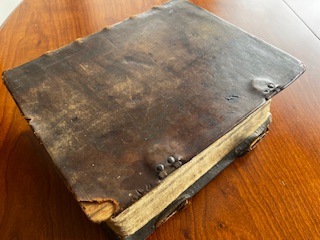
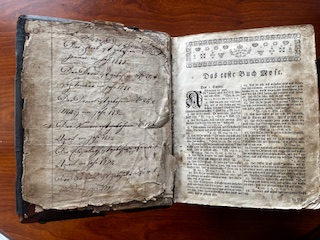
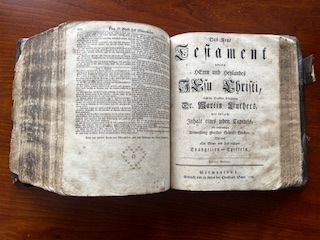
Recently, one of my nieces, Crystal Miracle, brought an old family Bible to one of our family gatherings for me to examine. She knew her Uncle John likes old books and is interested in anything to do with history. Bound in calfskin, missing the clasps and the title page, the Bible is otherwise in good condition. Birth records are written in it dating between 1777 and 1792. It is printed in German. It spent several decades in an attic in Henry County owned by a family friend that used to keep several of my nieces when they were children, and who gave it to Crystal because she had expressed an interest in it. It was clear this was something special, so I did some research on it.
Johann Christoph Sauer emigrated from Germany to the colonies in 1724 and had worked as a tailor, farmer, and in various other trades. By 1743 he had a printing business in Germantown, Pennsylvania – that, incidentally, competed with the printing business of Benjamin Franklin. Franklin used ‘Roman’ typefaces. When Sauer set up his business, he managed to acquire a set of ‘Fraktur’ type from Germany, and started printing books, calendars and newspapers in the typeface more familiar to his German customers. In 1743, Sauer printed a Bible – the “Hausbieble” – in German. At that time, in the American Colonies, British law prevented the printing of Bibles in English. Before Sauer printed his Hausbieble, there had only been one Bible printed in America – in the Algonquin Indian language.
Sauer was an interesting character. In addition to tailoring and printing, he had been a surgeon, watchmaker, cabinet maker, optician, and tool maker. It is believed that he built at least one of his printing presses himself. Sauer developed and marketed his own brand of ink.
Around 1732 his wife left him to become prioress of the Ephrata Cloister, a religious community of about eighty celibate Brothers and Sisters who wore white robes, lived austerely, and sought to prepare themselves for the Second Coming of Christ, which they believed would occur soon. Mother Sauer eventually left the Cloister and reunited with her husband in 1745.
Sauer was a controversial figure. His Hausbieble, for the most part, relied on Martin Luther’s translation, but replaced parts of the Apocrypha and part of the book of Ezra with sections from the Berleburg Bible, a different translation from the original Greek and Hebrew. As hard as it is to discern God’s will, it is harder to get human beings to agree on the finer points of faith. Sauer was criticized in the press and from the pulpit by the prominent Lutheran theologian, Henry Melchior Muhlenburg, for deviating from the standard Lutheran text and for his support of the Brethren in their separation from the Lutheran church.
After Johann Christoph Sauer died in 1758, his son Christopher Sauer, Jr. published two more editions of the Bible, one in 1763 and one in 1776.
Christopher Jr. was born in Germany in 1721, and arrived in the Colonies with his father in October, 1724. The younger Sauer became an ardent member of the Germantown Brethren congregation and was ordained as an elder in 1753.
Christopher Sauer Jr. was arrested by American authorities in 1778 for refusing to take an oath of loyalty to the State of Pennsylvania on religious grounds. General Peter Muhlenburg, brother of the theologian, helped Sauer petition General George Washington for release. Sauer was released, but not before his possessions had been confiscated by Pennsylvania authorities and auctioned off. He lived with his daughter Catherine until he died broke in 1784.
The 1776 edition of Sauer’s Bible was the fourth edition of the Bible printed in America. This year, it will be 250 years old. Although printed in German it is considered by many to be the first “American” Bible – printed in the year of America’s independence, with paper and ink manufactured in America, on a press made in America, and with a new set of type that had been cast in America. Sauer printed 3,000 copies of the 1776 edition, but fewer than 200 copies are believed to have survived.
During the Battle of Germantown in 1777, British soldiers came across the unbound pages of many of the copies. British soldiers used some of the loose pages for horse bedding, and used other pages to wrap gunpowder and bullets to make rifle cartridges. This is how the 1776 edition of Sauer’s Bible came to be known as the “Gun Wad Bible”.
Crystal’s Hausbieble is one of the few copies that was bound before the British troops turned the unbound pages into horse bedding and rifle cartridges.
The Gun Wad Bible is a rare and important artifact, significant in American history – and in Christian history. It is a treasure. It has been a privilege to hold it, look at it, turn the pages, and learn about it.